|
January 5, 2011 12:19:42
Posted By Peter W
|
Here it is! My list of the top music in 2010. Since I don’t much use play lists, these are albums not songs. Quite a bit of variety this year.
1. Gorillaz - Plastic Beach : Not all parts of this album is to my taste, but I can’t help being amazed at the quality and the variety.
2. Gaslight Anthem – American Slang
3. Band Of Horses – Infinite Arms : The better of the two albums on the list this year that make me yearn for new Fleet Foxes material. Great tunes.
4. LCD Soundsytem – This Is Happening ; Again, diverse, interesting, experimentally new.
5. Ben Folds & Nick Hornby – Lonely Avenue : Great collaboration. Amazing tunes and lyrics.
6. Paul Weller – Wake Up The Nation : And he did. Pperhaps the most under rated performer today!!
7. Take That : This one has to grow on you. A little bit of Green Day. A little Muse. Along with some Kinks-like lyrics.
8. Mumford and Sons – Sigh No More : The other one that echoes Fleet Foxes. This is a great album, but sometimes seems very repetitive in its tunes.
9. Deer Hunter – Halcyon Digest
10. Cee Lo Green - Lady Killer : Not my usual musical fare, but just full of raw energy, with a couple of really killer songs.
11. Elton John and Leon Russell – The Union : For sure a couple of old timers, but put them together and magic seems to happen. There was a big swing back to old school this past year with Plant’s new album, The Black Keys and others. This is the one that seems to pull off “old school” the best.
12. Peter Wolf – Midnight Souvenirs : OK, a little more old school. this one has solid, catchy tunes and moving performances.
|
|
December 28, 2010 08:31:10
Posted By Peter W
|
I guess it is time for my top movie list. I reserve the right to add a few later on as there are some promising ones I haven't gotten around to seeing yet, -specifically "Black Swan", "Life During Wartime" and "The King's Speech".
So far, though, I'd list it like this:
1. Inception - Undoubtedly the most complex and intelligent movie I've ever seen.
2. The Social Network - Like I said before, there's only so much you can do with narcissism, but a movie that can use sharp dialogue to keep you engaged has got my attention.
3. Kick Ass - Just because it was so audacious.
4. Winter's Bone - A powerful look at the dry rot in the heart of the American Dream.
5. 127 Hours - A movie that just had a lot of reference points for me, allowing me to enjoy it that much more.
6. Iron Man 2 - Stuff blows up!
7. Submarine - The movie I saw at TIFF that never got released. Too bad.
8. Let Me In - I go against the critics. I thought it was as good as, and perhaps even a bit better than the original.
Conspicuously missing from the list is "Youth In Revolt", which was the biggest disappointment of the year, and the new Harry Potter film, which comes across as a very long trailer for the next one.
Did I miss any?
|
|
December 17, 2010 09:14:52
Posted By Peter W
|
I don't get a live TV feed, so as a result most of my vid watching is on DVD or thumb drive. So, I feel kind of odd weighing in on this topic, but...
It seems that there is a serious flaw in the way TV networks interpret the ratings that they collect. People who tend to PVR their shows don't seem to count. As a result, shows like Fringe (which is at risk of cancellation) or SG:U (which was just cancelled), that find themselves stacked against sports playoff games or Dancing With The Stars (which seems to be on, in one incarnation or another, every night) are at a disadvantage. It discriminates against "nerds" who have the intelligence and inclination to record their favourite shows for alternative viewing times because they want to let (or are forced to let) another family member watch Dancing With The Stars or WWF. So the shows watched by those most inclined to use technology are the ones that will suffer. Apparently, you have to watch the program on the original broadcast in order to count. How archaic! Another example of TV and Radio shooting itself in the foot.
The natural consequence of such a policy is for TV viewing to devolve into a long chain of sports events and cheap, shallow reality TV. And then people will complain about how hollow TV is (-well, as if they already aren't-) and the networks will scratch their heads in puzzlement as everyone starts watching the Internet. Technology marches on, and those not capable of keeping step will fall behind and get lost. (Am I overdoing the metaphor?) Such was the case with the music industry and it's currently happening with radio.
|
|
December 6, 2010 10:16:50
Posted By Peter W
|
In addition to a few days of walking on beaches, exploring swamp hummocks, getting a lot of good photographs and finding some good restaurants, I also got a chance to do a fair bit of reading and even a lot of writing. Over the next week, I'll be dipping into all of this for ideas.
The drive down to Floriday amounts to about 24 hours, which I did in 3 stints on the way down (stopping for a day at Huntington Beach in S. Carolina) and 2 long stints on the way back. Keeping me company during this driving was Keith Richards in the form of his new autobiography, Life, on audio book. I have to say that it was a delight to listen to. His stories about the escapades of the Stones, especially during the 60s and 70s was delightfully entertaining. His recounting and self criticism of the horrors of heroine use are dramatic and equally interesting. It's definately a dramatically strong book with lots of drug stories and a generous dose of profanity. Although he gets off on a few tangents about certain unknown people (to me at least), giving more details than anyone probably wants, I have to say that at least 75% of the book is engaging and insightful. I recommend it to anyone, but it probably would be best for those over 30 and under 65. I would also strongly advise the audio book, as it is superbly read by Johnny Depp (a close friend of Richards') who brings his acting genius fully to bear on the text. I'm sure it is identical to what we'd hear if Richards read it himself. All in all, it made the miles fly by.
This book gets an A-.
|
|
November 18, 2010 10:16:08
Posted By Peter W
|
The story line for Hereafter follows three separate situations, merging them together into one common point in the final ten minutes of the film. As storytelling goes, it’s nicely done, bringing into play a kind of mystical synchronicity which suits the central ideas of the story well. Each of the stories has its own compelling weight. The acting and all the technical cinema stuff was quite good...
And yet the movie left me unsatisfied. It’s like it was all introduction and then when things got more meaningful it was over. As the final scene faded out I certainly didn’t feel like there was any kind of closure. The writer would probably tell you that this was deliberate, but it still didn’t feel right. ...Like a superficiality.
This movie gets a C+ ... or maybe a B- ...somewhere around there.
OK, enough of these slow paced movies. I need to see something blow up!
|
|
November 13, 2010 11:19:52
Posted By Peter W
|
Yes, this is an unsolicited promotional statement.
I think that Cinema Clock is a fantastic movie guide website that more people should use. It is much more than just a source of info for where and when movies are playing, although it does a great job of that. It is the reviews and ratings of movies that are really valuable. Hundreds of reviews are regularly posted for movies, even obscure ones. The reviews involve ratings along with demographic information so that when you look up a movie you not only can see overall ratings (on a scale of 10), but it is analysed according to age and gender. So you can determine that a movie appeals more to women or men, and whether it appeals to young or old. You can then go to the actual reviews to check out comments and even respond to them (if you really have nothing better to do).
Hundreds of reviews by ordinary viewers is a nice change from the slick and often smug reviews written my critics in the media or accessed on Rotten Tomatoes. They have their place, but often they don’t jive with the opinions of the average moviegoer. And if the latest installation of some mindless, frat-boy comedy gets great reviews from viewers, but is panned by the critics, it is easy enough to figure out by looking at the spread of ratings and the actual reviews.
One of my favourite types of movies is the art film that only gets ratings of 10 or 1. People either love it or hate it. Those are often the most interesting films, although occasionally they tend to be stinkers. One of each of these are Uncle Boonmee and Never Let Me Go.
Uncle Boonmee Who Can Recall His Past Lives, is a movie from Thailand which got amazing reviews from the art film circle when it originally came out. It is listed as a comedy, which I just don’t get. In fact I don’t think I got it at all. It’s possible that I missed something, especially since I think I slept through some of the scenes where the camera remained unmoving on a bush or tree for several minutes, or a monk taking an uneventful shower. The most interesting scene involved what I think was a catfish raping a woman. (At least it wasn’t a typewriting, as in Naked Lunch.) If this film was complimented just because it was a film from Thailand, that’s like praising a scribbled drawing from a blind person. It’s not enough. Seldom have I ever been in a film where I was looking forward to the end of the ordeal. I kept looking for some kind of “past lives” theme or some layers of meaning, - and they were totally elusive.
This one gets an F
Never Let Me Go is a Sci-Fi thriller based on a famous novel by Kazuo Ishiguro. It is a slow, plodding, vey gothic film, which is why it scored a lot of very low ratings. However, it’s strength is in the darkness of the mood and the depressing melancholy of the characters, -if you’re into that sort of thing. It does what it does exceptionally well, but it’s not and never attempts to be an action film. Lots of people can’t handle that. Not popular with the younger crowd, although it does have a decent romantic side to it.
This one gets a B+
|
|
October 22, 2010 09:05:32
Posted By Peter W
|
The theme of “innocence to experience” or “coming of age” has been a predominant theme in literature, drama and film throughout history. From Pollyanna to Anne of Green Gables, -from David Copperfield to Harry Potter literature stories have painted the challenges of growing up on the backdrop of innocence and in that contrast has sharply defined many human qualities. Ken Wilber says that the time of greatest personal evolution and development occurs up to the mid twenties. This is when major elements of our personality and how we see the world are established. Afterwards, there are other challenges connected to jobs, relationships and parenting, but the moral and conceptual fabric of our lives is largely crystallized during that first 25 years. (Until, perhaps, the onset of mid life crisis or retirement.) It’s a question of horizontal versus vertical development.
I am very partial to “coming of age” movies, telling stories of adolescents, teenagers or young men and women learning how to become who they’re predominantly going to be as an adult. Since I’ve spent my life as an educator in several arenas, I see this development as the critical element of education. The minor part of education is knowledge. The major part of it is the development of values, perceptual and conceptual perspectives, and the evolution of consciousness/awareness so that this knowledge has a fertile medium in which to grow. Coming of age movies highlight these particular challenges and focus them in ways that usually can’t be done in a love story, historical drama or other genre (-not that these don’t have their own charm). That's why so many of them appear here. Movies like "12 And Holding" or "Submarine" spotlight those developmental qualities and add to our understanding of them.
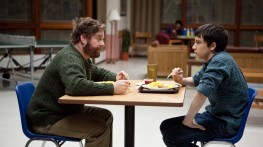
That’s a really long, roundabout way of introducing the movie, “It’s Kind of a Funny Story”. Stupid name, but great movie starring Zach Galifianakis and newcomer Kier Gilchrist as a 16 year old boy who checks himself into a psycho ward because he’s worried that he might commit suicide. There, he learns about his own life and his place in the world. It’s a dark comedy, reminiscent of “One Flew Over The Cuckoo’s Nest” but from a teenager’s point of view. I was impressed with the general quality of the film, especially Gilchrist’s acting which manages to capture a teenager’s inner psychological demons with subtle facial and vocal expressions. It’s not a kid’s movie, but it’s one that adolescents would probably identify with and enjoy.
This movie gets a B++.
|
|
October 19, 2010 02:30:04
Posted By Peter W
|
The series of books by S. M. Stirling, called The Change, take place in our world when all technology stops working. Most of the world's population does not survive, and the remaining people have to realign their lives along more primitive skills in a landscape where there are lots of hazards due to starvation. It is an epic story, spanning several generations and describing brave characters putting civilization back together again.
The books are well written, although Stirling has a passion for description reminicent of Charles Dickens. Most of the time that description reveals the details of primitive technology showing amazing research and deep thought. There are some times, though, that the description gets a little long winded, where scanning or skipping a few paragraphs is necessary in order to maintain interest. As a result, this opus series is now into its seventh volume, with another two on the drawing board. As much as I'm enjoying them, I can't help but wonder if the main character (or maybe the author, or me) might die of old age before he gets home from his quest. I don't relish the idea of having to wait another two years in order to see the ending of this story.
For those of us with an interest in survival and primitive technology, I really strongly recommend these books. As I said, Stirling has done his research, and the post-devestation world he paints is realistic and enlightening.
SciFi and Fantasy series each often create a whole unique universe in which to play. Some of the best works of fiction fall into this category.
The best, I believe, is the Dune series, first created by Frank Herbert and carried on by his son. The original seven books start off masterfully, but tend to become a little less engaging as they progress. The dozen or so penned by his son, Brian Herbert, have all been of a very high quality. This series has spawned two computer games, a board game, and three movies. The scope of the story is majestic and profound.
Orson Scott Card's Ender series is a close second. The five Ender books and the five Shadow books work together to tell one complete story. Two of the books won Hugo awards and the first Shadow book really should have, easily being one of the top ten SciFi books ever written.
His Dark Materials, a series by Philip Pullman, is surrounded by controversy, because of its authors pro-atheist statements. (The first volume is best known as "The Golden Compass".) Personally I don't understand this. While Pullman's books are clearly anti-religion and church, they don't strike me as being atheistic. There is a spiritual thread running through the books which has a Deist or Taoist sentiment. The story is rich, and the ideas are thought provoking.
The newest series that has demonstrated its excellence is the WWW Trilogy ("Wake", "Watch" and "Wonder"). Robert Sawyer has always struck me a little pompous and full of himself (especially on his web site), but that seems to work in his favour in this series, where he is really spilling his thoughts onto the pages, putting forth opinions on a variety of random topics, but managing to still achieve some cohesion. The central concept of an emerging intelligence on the Internet explores the nature of consciousness in a way only SciFi can.
Other series would include Farmer's Riverworld series, Niven's Ringworld series and Pohl's Gateway series. Of course you can't forget the grandparents of SciFi/Fantasy, The Lord of the Rings and the Foundation series (although I've never been that impressed with the latter.)
Creating and animating a universe is one of those things only SciFi and Fantasy can do properly.
|
|
October 14, 2010 10:26:22
Posted By Peter W
|
Still on the subject of movies, there are two non-mainstream films that I'm anxious to see in the next few weeks.
The first is a Danish film called "Deliver Us From Evil" and the second is called "Winter's Bone". People often ask me where I find these films. Well, in this case both are highly recommended in various magazines including Rolling Stone, Macleans and several British misic mags that I enjoy. NOW magazine is also a good source of movie reviews and gives a good heads up on cultural events coming to Toronto.
However, both of these movies are only playing in limited engagements. "Deliver Us From Evil" has a run at the Carlton (which I'm really glad has reopened), while Winter Bone has a three night run at the Fox Theatre. (I think perhaps "Winter Bone" may have been playing more widely back in June.) These films receive fantastic reviews and are among the best made. On Cinema Clock, a site where the public can rate and write reviews on movies, these kinds of movies are always given the highest ratings by the movie going public, so it's not just snobby movie critics who value these films. Andy yet they are the least distributed. Crappy mainstream movies play the big theatres for months, while quality films get a week or a few days at an obscure downtown theatre.
I know that it is what the public wants. But as Paul Wellar says, "The public wants what the public gets.) and I can't help but thing that if some of these films were given slightly wider distribution, even with some kind of special arrangement, many more people would discover these quality films before they disappear into DVD oblivion. Perhaps one theatre in a 20 theatre mega-complex, could be devoted to alternative films. Perhaps one night a week. I'm sure that it would be financially positive. The last few movies I've seen in mainstream theatres have only been about 20% full. I'm sure some of these alternative films can do better than that if offered in limited showings. It would provide more variety, maybe expose a little cultural quality, and probably help the theatres economically as well.
My guess is that it is an industry problem, where distribution is controlled by rules and licenses. If the industry's rules are choking the wider distribution of quality films, it can't be good for business.
|
|
October 14, 2010 10:18:52
Posted By Peter W
|
Here is a quick review of two mainstream movies seen in the past few weeks.
“The Town” is a heist movie starring and directed by Ben Affleck. The story line has a unique twist of a kidnapper befriending his victim without her knowing who he is, and a relationship developing. It provides a good setting for Affleck’s conflicted mind and motives and, of course, sets up the emotional scene where the victim finds out that her new lover is the man who terrorized her. I’m not really giving anything away here. Right from the beginning, you know it’s destined to happen.
The problem I had with the movie is the portrayal of Affleck’s character in a heroic light. We’re supposed to sympathize with him because he let his victim go and because he wanted to escape his life and start over. And yet he is portrayed as an unrepentant bank robber who is willing to shoot and kill police officers in a gun fight. His efforts to turn his life around are weak and ineffective. I, for one, felt no sympathy for him and was a little offended by the film trying to foster sympathy.
This movie gets a B.
“The Social Network” is the story of Mark Zuckerberg and the inception of Facebook. Zuckerberg has referred to the movie as fiction, but neither he nor Sean Parker (the developer of Napster) , who was painted in a particularly negative light in the film, have made any strong statements against it, which leads one to believe that they probably just want it to go away. Zuckerberg is painted as a self centred, socially retarded genius whose prime motivation for developing Facebook was spite felt when he was snubbed by his girlfriend and the frat boys of Harvard’s elite. Although he is not a very likeable character, he is very interesting and it is easy to understand his motives, perhaps even sympathising with him a little. This is a great film. No action. All cutting dialogue and character development, -so if that doesn’t appeal to you, be warned.
This movie gets an A-.
Finally, just a work on “Machete”. I wonder how well it’s dong in Texas and Arizona theatres...
|
|
|
|
