Posted By Peter W
4graph


From Grasping Reality With Both Hands

   Fifty years ago we thought that technology and innovation would result in shorter work hours and a higher standard of living.  Instead everyone is working longer hours, two incomes are required to maintain high standards in most households and this is all in spite of higher productivity.  What happened?? 

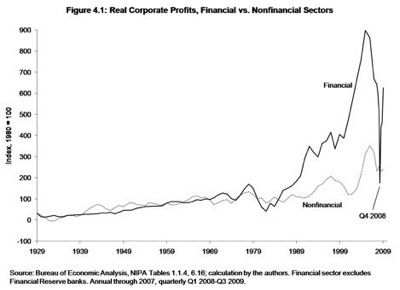
   This graph points to at least one strong factor in this irony.  Look at bank profits compared to other corporate profits. And don't forget that the wages of the average bank workers, such as the tellar, have not increased beyond any normal expectation.  The extra profits are clearly going to the top.  The higher level financial moguls are siphoning off the benefits of everyone's increased work and production.  That really would be less of a slap in the face if they really deserved it, however based on the recession of the past few years and the fact that this same financial aristocracy is largely responsible for it, I for one don't think it is deserved.

   When you look at this graph, don't miss the dip at the recession, -and the immediate recovery.  Compare it to the more moderate dip in the non-commercial profits (and the lack of recovery), indicating that the crisis was very much caused and perpetuated by financial institutions.  Unemployment in the non-commercial sector was fallout from financial sector failures, -not the other way around.


Posted By Peter W

     I don't get a live TV feed, so as a result most of my vid watching is on DVD or thumb drive.  So, I feel kind of odd weighing in on this topic, but...

     It seems that there is a serious flaw in the way TV networks interpret the ratings that they collect.  People who tend to PVR their shows don't seem to count.  As a result, shows like Fringe (which is at risk of cancellation) or SG:U (which was just cancelled), that find themselves stacked against sports playoff games or Dancing With The Stars (which seems to be on, in one incarnation or another, every night) are at a disadvantage.  It discriminates against "nerds" who have the intelligence and inclination to record their favourite shows for alternative viewing times because they want to let (or are forced to let) another family member watch Dancing With The Stars or WWF.  So the shows watched by those most inclined to use technology are the ones that will suffer.  Apparently, you have to watch the program on the original broadcast in order to count.  How archaic!  Another example of TV and Radio shooting itself in the foot.

     The natural consequence of such a policy is for TV viewing to devolve into a long chain of sports events and cheap, shallow reality TV.  And then people will complain about how hollow TV is (-well, as if they already aren't-) and the networks will scratch their heads in puzzlement as everyone starts watching the Internet.  Technology marches on, and those not capable of keeping step will fall behind and get lost.  (Am I overdoing the metaphor?)  Such was the case with the music industry and it's currently happening with radio.


Posted By Peter W

     It must be Halloween.  With the season comes a new crop of violent and scary horror flicks.  In lockstep with that comes a new study reportedly showing a connection between violent movies/games and consequences in teenagers, with the understood conclusion that such games and movies are detrimental to general behaviour. 

When I leave an action movie, especially one that has car chase scenes, I feel an exhileration when I get into the car to drive home.  I feel like I should be speeding through the streets and driving aggressively.  Do I do it?  No, not usually.  Do I feel the same a half an hour later?  No, not at all.  The "rush" which may have been excitement, or adrenaline or may have been some kind of cognitive push, or (as this study suggests) an overstimulation of a specific part of my brain, Has faded away with no evidence at all that there is permanent or long term behavioural change. 

If you look carefully at this and other similar studies, -and, as you know, I always encourage that any studies and statistics be carefully examined-, you see that there is no mention of long term behavioural change in the subjects.  The study points to brain activity and hormonal changes during and immediately after engaging in violent media.  There is, in fact, no measurement at all of behaviour.  Therefore, there should be no conclusions about behaviour, other than what the teenage boy may do during the participation in these media.  Also, I would suspect that you would find similar physical reactions to similar aggressive sports, such as hockey, where on ice fights are not uncommon.  (In fact, the physical and probable long term effects are likely to be even stronger in sports because it is direct physical engagement wrapped in a way of life that extends beyond the ice rink.)

It is possible and likely that the violent movie or game has stimulated a measure of excitement and engagement, which is definitely going to produce heightened biochemical and neurological activity.  I used the word "rush" above, and that is at least a major part of what is happening here.  To infer more, is just that, -an inference.

In order to conclude anything about long term behaviour, you have to measure long term behaviour.  That's not likely to happen, because psychology ethics is not going to allow you to randomly divide a group of teenage boys into two groups, then routinely expose half of them to violent media in order to measure long term behaviour, like whether they get into more fights or engage in criminal activity.  But any other kind of study has got to admit that their conclusions are highly suspect.  Studies that correlate hours of violent gaming to aggressive behaviour cannot prove causality.  They have no way of proving whether the behaviour is the result of the gaming or the gaming is a result of the behaviour. 

I think most teenagers have the ability to distinguish between fantasy and reality.  It's called, achieving the "age of reason".  Those teenagers who become over stimulated by violent media, are violent in their predisposition already and are going to find an outlet for that urge one way or another.  It is in the area where the distinctions between fantasy and reality are blurred where we have to be really careful (like aggressive sports or media that masquerade as real life).  Desensitization from watching the news and seeing the parade of corrupt politicians, religious leaders, military officers, etc, does more to desensitize morality in a teenager than playing any video game. 


Posted By Peter W

     CFTR, 680 News Radio often deals with thin news days by adding stories about interesting surveys, studies or other statistical nonsense.  The inability of most people to properly analyse statistical studies means a constant flow of misinformation.


     Take for example last week's story about Canadians and their use of profanity.  The big story was that 56% of Canadians admitted to using profanity on a "regular or occasional basis".  This is compared to 51% in Britain and 46% in the U.S.   Conclusions?  Canadians are less poite and more profane than in other countries.


     Nonsense.  What it more likely means is that Canadians are more honest than those asked in other countries.  Or it may mean that Canadians have a different concept of what constitutes "occasional" use.  No real conclusions about Canadian behaviour is really justified. 


     Statistics are powerful things because they command validity, but without a proper understanding of basic statistical theory, abuse of statistics is rampant.  That's why, as a teacher, I always felt that the statistics portion of the math program was essential.  Almost every statiescal story I hear on the radio has flawed conclusions.


Google

User Profile
Peter W
Male
Uxbridge, Ontario, Canada

 
Category
 
Archives
 
Visitors

You have 163741 hits.