|
December 30, 2010 08:36:42
Posted By Peter W
|
One of the 100 top scientific stories in this month's "Discover Magazine" is about an experimental city being built outside Abu Dhabi, which is in the United Arab Emirates. This is a $20 billion city being constructed for about 40 000 residents. The intention is to make it an ultra-green city using alternative power and even electric cars. That's a lot of money, but it will provide a place to experiment with alternative technologies which may pave the way of the future.
OK, so somebody tell me why this is happening in the UAE! Sure, they have the money to do it, but that money, ironically, is coming from good old oil. Western countries want to liberate themselves from oil, -yes. But they also want to end dependence on the Middle East. Why are we not seeing an investment like this in the U.S., or in Germany, or even in Japan? The logical outcome of this would be that Middle East investments in new technologies will ensure that they keep a stranglehold on the energy consumption of the rest of the world. Smart business on their part, but not really smart for the rest of us.
The U.S.A. used to be the innovators of the world, but are so busy confusing science and religion that they're slipping out of the game. Canada has the opportunity to step in and make some major things happen, but I think we're still too small minded. Watch China and India. I'm sure they'll see the opportunities and jump on it before too long.
I don't know about the other countries, but one thing that UAE and China have that is going to be a huge advantage for them is that their governments have no qualms about concentrating resources at the top. Advancements have always been easier when rulers aren't afraid to concentrate resources. During the Middle Ages or the Renaissance, wealth was concentrated in the aristocracy. If it hadn't been, the advances made in this period of history never would have happened. If the rulers had been concerned with spreading the wealth evenly and uplifting the masses, we'd probably still be throwing our human waste out the window into the street. We like to think that human history has been a progression away from aristocracy, towards a more liberal equality, but that only really works if we have a society that is enlightened and advanced enough to make it work. We may be getting there, but we're not there yet, and competition from those that aren't afraid to designate resources (even at the cost of their populations) will have the upper hand.
I'm not really sure what that means. It's just food for thought.
|
|
December 30, 2010 02:18:54
Posted By Peter W
|
Here's an interesting list. Backpacker Magazine lists its 10 most dangerous hikes. More interesting is that I've done three of them, some several times.
#1 Abrams Falls, Smoky Mountains : It's not really the hike that's dangerous; it is about 2 miles of paved and graded trail. It's what you do when you get there. Swimming at the bottom of the falls is a blast, and relatively safe. Climbing up the falls and hiking at the top, on the other hand, is where you encounter risk. There are warning signs. There was also a time that we had to ford the river just after a hurricane had grazed us. Our campsite had been flooded and what was an ankle deep wade going in became a waist deep ford on the way out. When checking in at the end of the hike, the rangers asked why we hadn't waited for the helicopter that they'd sent in for us. Oh well...
#2 Bright Angel Trail, Grand Canyon : This is a deceptive statistic because of the number of people who use this trail every year. My hike on this trail usually spans three to four days, and I've never done it without hearing of at least one fatality either while we're there or within a week of it. Last time I hiked it, we overheard a call over a ranger's walkie about a man who had slipped over the edge while walking and fallen down a cliff. But that day, we were among at least a thousand people hiking up or down the canyon. The heat and strain on this hike is definately a killer. You have to know what you're doing, but it shouldn't scare anybody away.
#3 The Maze, Canyonlands, Utah : This is perhaps the hike where I've come closest to being in trouble. It's called "The Maze" for a reason, but we didn't get lost as we were very conservative in sticking to the trail. It was a blistering hot day, with little shade in these canyons. The hike took a lot longer than we'd estimated, and by the end of the day we were hiking straight up a huge switchback in the afternoon sun with no water. Running to the car, we opened up the cooler for liquid relief. One of the guys in our party had been collecting unusual beer cans along our trip, and we hadn't gotten around to emptying them yet. We made very short work of them before driving out, -perhaps not the best move when dehydrated, but it all worked out for the best. American beer, you know... pretty close to water.
I wimped out on Half Dome. ...Mmm, what's Buckskin Gulch? Better look it up and plan a trip.
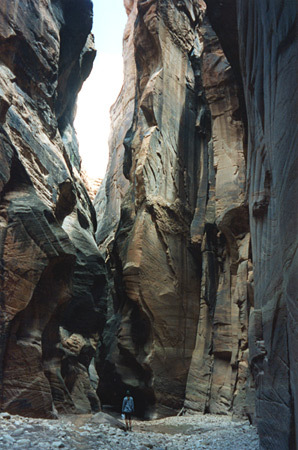
Oh yes! Definately!
|
|
December 27, 2010 11:49:24
Posted By Peter W
|
I came across an interesting experiment described in Science and the Akashic Field - An Integral Theory of Everything, by Ervin Laszlo (-my current light reading). The study will be of particular interest to those students of mine who have engaged in group meditation instruction.
The study was conducted at the National University of Mexico by Jacobo Grinberg-Zylberbaum. He worked with an experimental group who were connected by having meditated together, and a control group of random people. When separated, he found that those with the common connection of meditation were able to "sense' the sensations of the others. This wasn't done with mind reading or anything like that. It was done by measuring brain wave EEG responses and Galvanic skin responses, -in other words, purely with sub-conscious responses. When one "sender" was stimulated with loud noises, bright lights or mild electric shocks, the receivers with the common connection consistently showed a common response 25% of the time, while those without the connection showed only random results. Strong synchronized responses were also shown between couples that were closely connected in other ways, such as being lovers or twins.
Russell Targ and Harold Puthoff showed similar results back in the 1970s, but unfortunately have damaged their credibility with studies of Uri Geller and involvement in Scientology. Their earlier studies may or amy not have any merritt.
I find this interesting because we've had many groups of people who have shared common meditations for prolonged periods of times. Some of my groups have meditated together for as long as four years. During those periods there always seemed to be a closeness and bonding that was exhibited by the members, some of which are still very close.
The implications here are very interesting. Could common experiences such as group meditation work as an entry gate to empathy? It also brings up many questions about the potential for non-local, quantum entanglement and how it may create an inhearent connection between people and perhaps all living things.
|
|
December 27, 2010 09:02:22
Posted By Peter W
|
From Grasping Reality With Both Hands
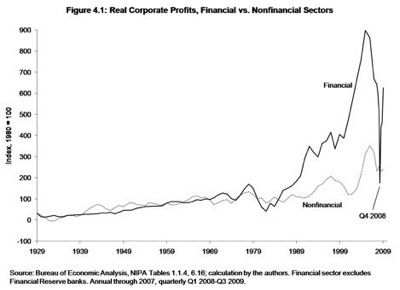
Fifty years ago we thought that technology and innovation would result in shorter work hours and a higher standard of living. Instead everyone is working longer hours, two incomes are required to maintain high standards in most households and this is all in spite of higher productivity. What happened??
This graph points to at least one strong factor in this irony. Look at bank profits compared to other corporate profits. And don't forget that the wages of the average bank workers, such as the tellar, have not increased beyond any normal expectation. The extra profits are clearly going to the top. The higher level financial moguls are siphoning off the benefits of everyone's increased work and production. That really would be less of a slap in the face if they really deserved it, however based on the recession of the past few years and the fact that this same financial aristocracy is largely responsible for it, I for one don't think it is deserved.
When you look at this graph, don't miss the dip at the recession, -and the immediate recovery. Compare it to the more moderate dip in the non-commercial profits (and the lack of recovery), indicating that the crisis was very much caused and perpetuated by financial institutions. Unemployment in the non-commercial sector was fallout from financial sector failures, -not the other way around.
|
|
December 19, 2010 09:21:20
Posted By Peter W
|
I've made a few comments recently about the anaemic state of journalism. Here's a story spotlighting that and WikiLeaks.
I understand that Michael Moore may not be the most esteemed source of valid information, but in this case the facts seem to be in his favour. On Jan. 31, 2008, just after the nomination of SICKO for an Academy Award, the American State Department released an internal memo claiming that SICKO was banned in Cuba because Cubans were upset and rebelling since they actually were not receiving the kinds of health benefits described in the film. This was a total lie, as the Cuban government had even sought permission for and had aired SICKO on national television after it had been playing in Cuban theatres for months. So what? I guess this really just amounts to a case of the U.S. government lying to itself, so it really just becomes a matter of integrity and shouldn't be a big issue. (Unless you remember that the war on Iraq was, more or less, a result of the same process of a government lying to itself.)
As interesting as that is, it's not the main point. Last Friday, WikiLeaks exposed this inaccurate memo to the press. What did the press do? They reported it as fact, without understanding the irony or checking their information. Any brief Google search would have shown them that the information was false (and probably have given them a much better story). Wow! WikiLeaks handed them a lie and they turned it back into a truth. Therein may lay the real damage that can be done by WikiLeaks, -the misinterpretation of powerful information by a stupid and lazy news media.
Moore get's the final word, as quoted from his Blog:
"OK, so we know the media is lazy and sucks most of the time. But the bigger issue here is how our government seemed to be colluding with the health insurance industry to destroy a film that might have a hand in bringing about what the Cubans already have in their poverty-ridden third world country: free, universal health care. And because they have it and we don't, Cuba has a better infant mortality rate than we do, their life expectancy is just 7 months shorter than ours, and, according to the WHO, they rank just two places behind the richest country on earth in terms of the quality of their health care."
|
|
December 18, 2010 11:48:37
Posted By Peter W
|
Top Ten lists abound at this time of year. Not to be outdone, "Enlighten Next" magazine published their "Top Ten Wacky Spiritual Workshops" in their just-released issue, and Toronto takes the top slot.
Ganga Yoga is cannabis-enhanced yoga, offered at the Hot Box Cafe in Kensingon Market. (Bring your own weed.) Personally, I always thought that Yoga and Meditation were about purification and balance, both of which may be more challenging when intoxicated in any way.
Other workshops to make the list included Doga (yoga with dog positions), Yoga and Pole Dancing (described as a "striptease aerobics class") and Punk Rock Yoga (-"how loud can you scream om").
Oh yes, and don't forget "Overcoming Fear with Yoga and Chocolate". Mmmmm...
|
|
December 18, 2010 08:49:01
Posted By Peter W
|
This month's issue of DISCOVER Magazine has is one I always look forward to, summarizing the 100 most significant scientific stories of the year. It actually results in a little highly needed optimism as it displays some of the most extraodinary accomplishments of our species.
One story that was prominent back in January at one of the big climate research conferences, was the hit taken by Global Warming Theory. Leaked e-mails and other documents cast doubt on the integrity of the scientific community, claiming that they'd exaggerated their findings to make Global Warming appear more extreme than it really was. It was a coup for the Global Warming sceptics, who, oddly, also seemed to support big oil and coal.
That story got a lot of press and was sensationalized. What didn't get a lot of press was the subsequent story that in five separate investigations following the accusations, the vast majority of the research called into question was exonerated. The idea that Climate Research as "broken" was totally proven false. This, however, never got significant press coverage and exposure. (A very few pieces of research were found to need some revision, however this is true of any body of research.)
Here is another example of our media journalists failing in their job. Whether it was because the story wasn't as dramatic as the original allegations, or whether the media was compromised by their sponsors, the fact remains that on this important issue it failed to be objective and to provide the public with unbiased information. They were ready to condemn Climate Change Research, but not to vindicate it when the evidence clearly proved that was justified, leaving the public with an inaccurate impression, -which just happens to coincide with the wishes of some big carbon producing industries.
|
|
November 23, 2010 09:32:13
Posted By Peter W
|
Last year about this time the previous version of this blog ended up in a long discussion about scientific and medical research. The discussion started about the controversy around flu shots and whether or not we should trust the medical "expert" opinion to take them. A lot of the discussion focused on the possible links between vaccines containing mercury and the causes of autism. Unfortunately, the discussion kind of bogged down there, with the participants more interested in beating to death one small issue rather that examining the bigger picture. The discussion turned to talking about the nature of scepticism, with the self proclaimed sceptics seemingly being sceptical of anything that questioned the status quo and supporting hard scientific research rather than questioning it.
Narrowing the discussion to any link between autism and vaccines misses the main point, regardless of whether that link eventually proves to be true or false. The big picture is the state of medical and pharmaceutical research, and whether it should be trusted. The big question is whether medical and pharmaceutical research is motivated by public interest or by profit.
Last month's Discover magazine contained a great article titled "Reckless Medicine", which sums up the criticisms and scepticism that I was trying to focus on last year. Its research shows that "Less than half the surgeries, drugs and tests that doctor's recommend have been proved effective." While a lot of money goes onto research and development in order to get a product or procedure approved, less than 1 % of funding goes into any follow up research to judge whether it is effective, -and the little research that is done strongly suggests that effectiveness is random and unreliable. Drugs are misrepresented to doctors. Medical procedures often cause more harm in side effects than the good they are intended to do. Many surgeries are completely unnecessary. Discover is admittedly a lay magazine, but this article is well researched and shows with solid arguments that depending on medical experts to make scientifically sound decisions about medical treatment (including whether or not taking the flu vaccine is advisable) is far from a sure thing.
Sceptics should question the status quo, not the alternatives.
|
|
November 13, 2010 11:19:52
Posted By Peter W
|
Yes, this is an unsolicited promotional statement.
I think that Cinema Clock is a fantastic movie guide website that more people should use. It is much more than just a source of info for where and when movies are playing, although it does a great job of that. It is the reviews and ratings of movies that are really valuable. Hundreds of reviews are regularly posted for movies, even obscure ones. The reviews involve ratings along with demographic information so that when you look up a movie you not only can see overall ratings (on a scale of 10), but it is analysed according to age and gender. So you can determine that a movie appeals more to women or men, and whether it appeals to young or old. You can then go to the actual reviews to check out comments and even respond to them (if you really have nothing better to do).
Hundreds of reviews by ordinary viewers is a nice change from the slick and often smug reviews written my critics in the media or accessed on Rotten Tomatoes. They have their place, but often they don’t jive with the opinions of the average moviegoer. And if the latest installation of some mindless, frat-boy comedy gets great reviews from viewers, but is panned by the critics, it is easy enough to figure out by looking at the spread of ratings and the actual reviews.
One of my favourite types of movies is the art film that only gets ratings of 10 or 1. People either love it or hate it. Those are often the most interesting films, although occasionally they tend to be stinkers. One of each of these are Uncle Boonmee and Never Let Me Go.
Uncle Boonmee Who Can Recall His Past Lives, is a movie from Thailand which got amazing reviews from the art film circle when it originally came out. It is listed as a comedy, which I just don’t get. In fact I don’t think I got it at all. It’s possible that I missed something, especially since I think I slept through some of the scenes where the camera remained unmoving on a bush or tree for several minutes, or a monk taking an uneventful shower. The most interesting scene involved what I think was a catfish raping a woman. (At least it wasn’t a typewriting, as in Naked Lunch.) If this film was complimented just because it was a film from Thailand, that’s like praising a scribbled drawing from a blind person. It’s not enough. Seldom have I ever been in a film where I was looking forward to the end of the ordeal. I kept looking for some kind of “past lives” theme or some layers of meaning, - and they were totally elusive.
This one gets an F
Never Let Me Go is a Sci-Fi thriller based on a famous novel by Kazuo Ishiguro. It is a slow, plodding, vey gothic film, which is why it scored a lot of very low ratings. However, it’s strength is in the darkness of the mood and the depressing melancholy of the characters, -if you’re into that sort of thing. It does what it does exceptionally well, but it’s not and never attempts to be an action film. Lots of people can’t handle that. Not popular with the younger crowd, although it does have a decent romantic side to it.
This one gets a B+
|
|
September 29, 2010 09:44:00
Posted By Peter W
|
I really don't t want this to turn into a blog about religion, but some of the juiciest stories lately have been religion related.
Yesterday a survey conducted by The Pew Forum on Religions and Public Life was released with some eye opening results. The study, conducted by a religious organization, presented a set of questions about Christianity and other religions to a large survey population of Americans. The survey and analysis look statistically sound and can be found here.
The results indicate that on average people with a Christian religious leaning have the least knowledge not only of religions in general, but also of their own Bible. Atheists, Agnostics, Jews and Mormons scored the highest overall, and proved to be more knowledgeable about the Bible and Christianity than all Christian groups except White Evangelists. Those same White Evangelist, though, scored near the bottom of the list when it came to questions involving any other religion except their own and even on questions involving the role of religion in public life (such as the teaching of religion in public schools). Fewer than half of those surveyed knew who Martin Luther was or could identify the four main Gospels of the Bible. Almost half believed that the Golden Rule was one of the Ten Commandments.
There are all kinds of conclusions which might be drawn from this, which are going to be contentious and controversial. One might look at the relationship between religious belief and intelligence. One might ask questions about "true believers" not really being informed in their beliefs. One might point to the importance of wide religious education being necessary in school systems in order to foster more understanding an fewer misconceptions.
Certainly this reflects on Christian zealots who criticize and pass judgement on other religious, when it seems that only a minority of them know what they're talking about.
Read the survey. It's American, but, like most survey information, it has relevance in Canada, if only to warn us what we need to avoid in our own cultural evolution. The stats are clearly presented and are broken down for quick analysis. I think it raises an awful lot of questions and issues, and probably has a lot of fundamentalist groups squirming a little.
(There are copies of the questions available on the web site (in an Appendix) if you want to test your own knowledge, but you should take it before reading the spoilers in the results.)
|
|
|
|